
Budget 2026: small changes, little to build on for founders
The Budget avoided the damage founders feared but offered little growth policy, with a narrow Founders' Relief and a halved BADR limit.
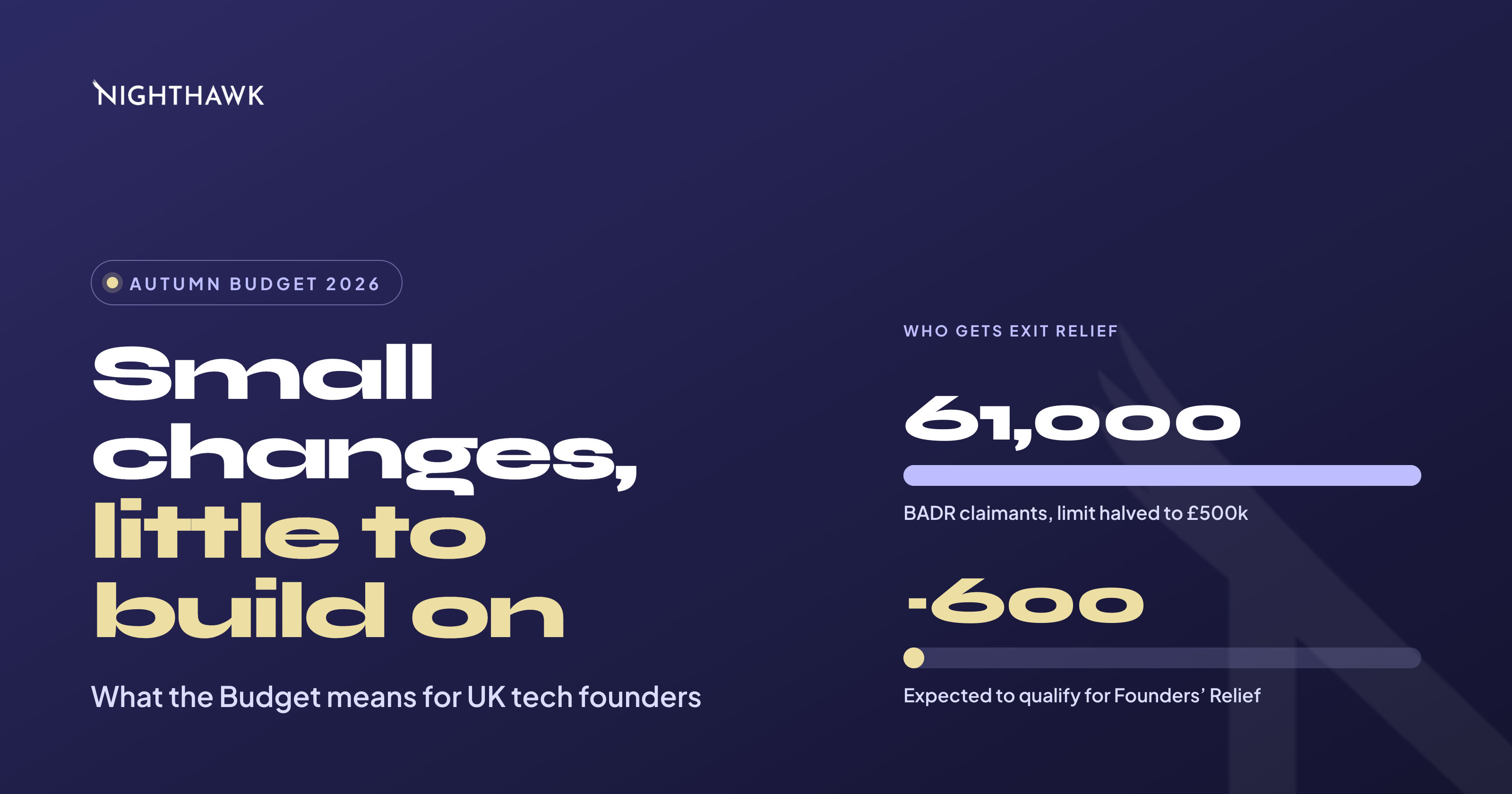
Wednesday's Budget gave founders a lot of small adjustments and very little to build on. John Healey's first Budget tweaked allowances, thresholds and admin forms across the board. What it did not deliver was a policy that changes the economics of starting, hiring or scaling a UK tech business.
Founders went in braced for the worst: 61% expected a bad outcome and just 7% a good one (Entrepreneurs Network / Blick Rothenberg survey). The worst did not happen. But the measure billed as the big win for founders turns out to be one most of them will never use, paid for in part by cutting the relief they actually rely on.
As a lender to early-stage, tech-enabled businesses, we look at a Budget through four questions. What do founders keep when they sell? What does it cost to run the business until then? Will investors keep investing? And what does it cost to borrow?
Key points
- Founders' Relief is built for the few. A 10% CGT rate on up to £10m sounds generous, but HMRC expects only ~600 people a year to qualify.
- BADR is halved for everyone else. The lifetime limit falls from £1m to £500k from April 2027, hitting a pool of 61,000 annual claimants.
- Hiring costs are untouched. No cut to employer National Insurance, founders' top ask, while the National Living Wage rises 3.9%.
- Lots of tinkering, little growth policy. Higher allowances, simpler forms and doubled EMI limits help at the margins, but nothing shifts the economics of scaling.
- Borrowing stays expensive. The 10-year gilt is above 5.3% and the Bank of England is expected to raise rates.
Founders' Relief: a headline for the few, a cut for the many
The Budget's flagship founder measure is a new Founders' Relief: a 10% capital gains tax rate on up to £10m of lifetime gains, from 6 April 2027. On paper, that is worth up to £1.4m per person against the 24% main rate. In practice, almost no founder will see it.
To qualify, a founder must clear every one of these hurdles (Forsters, Business Sale Report):
| Test | Condition |
|---|---|
| Founder stake | At least 25% of ordinary share capital when the company started trading |
| Holding period | Shares held for at least 5 years before sale |
| Residence | UK resident for at least 5 continuous tax years before sale |
| Size | £10m+ turnover and 15+ full-time employees in the year before sale |
| Same trade | Still carrying on the trade it was founded for |
| Growth or innovation | Two of three: 25% compound turnover growth over 3 years; 25% compound headcount growth over 3 years; £1.5m+ qualifying R&D spend |
HMRC's own numbers make the point. It expects around 600 individuals a year to claim, across roughly 400 businesses (BM Magazine). In 2024–25, 61,000 people claimed Business Asset Disposal Relief (HMRC). Founders' Relief reaches roughly 1% of that group.
Meanwhile, everyone else loses. The BADR lifetime limit halves from £1m to £500k from April 2027, on top of the rate already rising from 10% to 18%. A founder selling with a full allowance now saves £30k, down from £60k. The cut applies to all 61,000; the new relief to a few hundred.
The design misses how venture-backed companies are actually built:
- Pivots are penalised. The same-trade test catches start-ups that changed direction after their first idea failed, which is most of them.
- Co-founders and later hires are out. A team of four splitting equity evenly fails the 25% test from day one. Management that built value through EMI options never qualifies.
- R&D becomes a tax trap. If HMRC successfully challenges an R&D claim, the innovation test can fall away and the relief with it, plus back-tax and interest.
- The bar is a finished success story. £10m turnover, 15 staff and three years of 25% growth describes a scale-up at exit, not the founders who need encouragement to start.
The IFS's Helen Miller said she was "struggling to imagine an economic rationale" for the relief.
The IFS's Helen Miller said she was "struggling to imagine an economic rationale" for the relief (Accountancy Daily). Buzzacott's Matthew Katz expects "relatively few founders will qualify" (Forbes).
Consultation open
The relief is still at consultation, which closes on 30 November 2026. That is the window to widen it.
A Budget of small changes
The pattern beyond exit relief is the same: many minor adjustments, no single measure that moves a founder's cash flow in a meaningful way.
| Measure | What changed | What it means for a tech start-up |
|---|---|---|
| Employer National Insurance | No change | The biggest cost of hiring stays where it is. Founders' top request went unanswered. |
| National Living Wage | Up 3.9% from April 2027 | Higher payroll costs, with no offset. |
| Small business rates relief | 100% relief threshold up from £12k to £18k | Retail, hospitality and leisure only. Most tech businesses get nothing. |
| EMI share options | Individual limit doubled to £120k; 15-year exercise window | Useful for retention. Does not touch cash. |
| Trading allowance | £1k to £3k | Irrelevant to a venture-backed company. |
| Capital allowances | First-year allowance 40% to 50%; writing-down allowance 14% to 12% | Mostly a timing shift, and asset-light software businesses barely use it. |
| R&D tax relief | Claim notification form removed; additional information form simplified | Less admin. Rates unchanged, so no more cash. |
Sources: Saffery, Opus, Forbes.
None of these is bad in isolation. Together they read as housekeeping. techUK's verdict was that the Budget "did no harm" but that "nothing in yesterday's Budget... is game-changing" (techUK via Wired-Gov). With the OBR forecasting growth of around 1.0% in 2027, the economy needed more than housekeeping.
Investors: the pipeline survives
The good news is what did not happen. CGT was not raised to income tax levels, and there was no attack on EIS or VCT reliefs. The government instead promised to make scheme administration easier (techUK).
That matters because the UK starts from a strong position. UK venture firms raised a record $6.9bn across 31 new funds in Q3 2026, and UK startups raised $6.1bn in the same quarter. Leaving exit economics broadly intact keeps that capital flowing.
The British Business Bank also gets £5bn of extra capacity, including a new venture debt offer (GOV.UK), reported at £450m. The Bank says it will work with commercial lenders to unlock facilities for high-growth companies, recognising that scale-ups need growth capital without giving up more equity (Finance Connect). That is one of the more constructive measures in the Budget: more debt capital flowing through specialist lenders means more choice for founders. Detail on structure and eligibility is still to come.
Borrowing costs: no relief in sight
Markets took the Budget calmly. The 10-year gilt yield closed at 5.32% on the day, close to its 19-year high of 5.53% earlier this month (MarketScreener). The OBR cut the government's fiscal headroom from £24bn to £15bn, and debt interest costs are up £14bn this year. The Bank of England is expected to start raising rates in November.
For founders, that means the cost of debt stays high, and a Budget that leaves hiring costs untouched does nothing to free up the cash flow that services it. Debt is repaid from the business's own cash, so measures that would have cut operating costs, employer NICs above all, would have done more for founders than any exit relief.
R&D tax credits and grants
R&D relief rates are unchanged, and the claims process gets lighter: the claim notification form goes from April 2027, and the additional information form is simplified from autumn 2027 (Saffery). Less admin is welcome, but it does not change the core problem for early-stage businesses: the gap between spending on R&D and HMRC paying out.
The new Founders' Relief also ties exit tax to R&D. Its innovation test requires £1.5m of qualifying R&D spend with relief claimed in the three years before sale. A robust, well-evidenced R&D claim now matters at exit as well as for cash flow.
For many tech businesses, R&D credits and grants remain the cheapest money they will raise. Nighthawk's R&D Advance releases up to 80% of an eligible claim before HMRC pays. Our Grants Advance funds up to 80% of Innovate UK or Horizon awards before the money arrives.
The bottom line
This Budget avoided the damage founders feared, but it did not back them. The headline founder relief rewards a few hundred people who have already won, while the relief most founders actually use is halved. Hiring costs, the thing founders asked to see cut, were left alone.
The Founders' Relief consultation closes on 30 November 2026. If the government wants a relief that encourages founders rather than rewarding a handful of exits, it should drop the turnover and headcount floors, lower the 25% stake test, and stop penalising pivots.
Until then, founders should plan their capital on the basis that little has changed: equity remains available, debt remains expensive, and cash flow is what keeps a business in control of its own runway.
Talk to Nighthawk Partners
Nighthawk Partners provides Venture Debt from £1m, Export Finance from £150k backed by UKEF, and Innovation Finance through our R&D Advance and Grants Advance. If you want to talk through what this Budget means for your business, get in touch.
Sources
- Business Sale Report: October Budget cuts BADR, adds narrow Founders' Relief
- Forsters: Budget 2026 — New CGT Founders' Relief and changes to BADR
- BM Magazine: Founders relief to reach about 400 firms a year, HMRC says
- HMRC: Capital Gains Tax commentary
- Accountancy Daily: Founders' relief 10% CGT tax break
- Forbes: Entrepreneurs give their verdict on Britain's Budget
- Saffery: Autumn Budget 2026 key tax changes
- Opus: What does the Budget mean for UK businesses?
- techUK analysis via Wired-Gov
- MarketScreener: Gilt yields ease in muted reaction to UK Budget
- GOV.UK: Budget 2026 press release
- Finance Connect: British Business Bank receives £5bn capacity boost